Wednesday, 20 May 2015

Book Review: David Simpson, The Rediscovery of Classical Economics

David Simpson, The Rediscovery of Classical Economics: Adaption, Complexity and Growth (Cheltenham, UK and Northampton, Mass.: Edward Elgar , 2013), 215
pp. +vi.

In Simpson’s view, twentieth-century equilibrium economics has distorted the main mission of the profession—to understand the processes of change and complexity in economic life.  Contemporary economic theory, Simpson contends, models the economy as a system tending toward equilibrium, a model borrowed from classical (pre-relativity and pre-quantum) physics. Instead, Simpson shows, the economy is dynamic, complex, and never in equilibrium.

The heart of Simpson’s analysis is his engagement with complexity theory. Briefly put, complexity theory posits that the actions of multiple actors give rise to emergent, large-scale structures and processes. Complex systems have five major attributes. They are dynamic and nonlinear; individual agents within such systems learn adaptively over time; agents interact with each other explicitly and directly; macro patterns emerge from a multitude of micro interactions between many agents; and, complex systems evolve through processes of differentiation, selection, and amplification. Thus, in Simpson’s view, the economy has more in common with biological systems than classical physics.

While others, like Brian Arthur, view the economy in much the same way, Simpson makes two important and novel contributions. First, as his title suggests, complexity economics is not new. It was how 19th century economists (at least up to Marshall) thought the economy worked. And the insights of complexity economics bear a striking resemblance to some of the work of the Austrian school. Second, Simpson argues for a renewed embrace of history and context over mathematical formalism. Simpson takes as a telling example the 2008 financial crisis and subsequent near-depression that occurred, despite that most equilibrium economists thought that panics and depressions were things of the past, having been mastered by Keynesianism and the Efficient Market Hypothesis in turn.

This book distills Simpson’s career in economics spanning nearly 40 years. Simpson has served in academia, industry, and government, giving him a unique and broad perspective on the theory and practice of economics. It is perceptive, thought-provoking, and engagingly written. It will be a welcome addition to the libraries of anyone interested in the history of economic thought as well as the roots of our current economic crisis.

David Hochfelder
History Department
University at Albany, SUNY
Albany, NY, USA

Sunday, 17 May 2015

Feminist Economists in the Greek Parliament, Part 1: Political Origins

In this blog series, Yuan Yang writes about her encounters with the Greek Parliament’s feminist economists. This week, she describes the political and academic origins of Antigone Lyberaki and Rania Antonopoulos.
When there are so few critical economists in politicsand so few women–it is emboldening to meet two feminist economists in one place: the Greek Parliament. Antigone Lyberaki is from the centrist party To Potami (The River), and Rania Antonopoulos is from the left coalition SYRIZA. Both were recently elected in the stunning January 2015 elections, which saw SYRIZA  claim 149 seats (one short of an absolute majority), and brought several smaller parties, such as To Potami, into Parliament.
Antigone Lyberaki is a feminist economist who has written extensively on economic policy, and used to lecture at the University of Panteion in Athens. She offered to meet me at the door of the Airbnb apartment I was staying at in the university district of Panepistimou. As I emerged, she smiled at me and looked at the front door curiously.
“How did you find this place?” she asks, and I explain that it was via a website. “When I was a student – forty years ago – I used to come here several times a week, every week, for meetings of the pro-European Communist Party of Greece.” “This very door?” “Yes, this very door, on the first floor. We had a party magazine, we had debates, we had meetings."
The rooms on the first floor are now padlocked and barricaded with chains.

Mural in central Athens (April 2015)
“Have your political views changed since university?” I ask Antigone. “I no longer believe in the abolition of private property,” she replies, “But I do believe in the overall goal: of a free and equal society.” Her methods have changed; not her objectives. She is attempting to achieve such egalitarian objectives through her position as To Potami’s parliamentary representative. Being a parliamentary representative means that Antigone has more opportunities to take the floor when she wants to intervene in parliamentary debate, that she gets a longer time limit, and that she can raise any political issue in parliament - regardless of the topic set for that day’s discussion. As a member of a small party, Antigone is kept on her feet.
Rania Antonopoulos, now SYRIZA’s Alternate Minister for Labour, also became awake to politics as a student activist in the pro-European Greek Communist Party. “In 1974, when the Greek dictatorship ended, there was a moment of mass mobilisation,” Rania recalls. “The student movement rose up, particularly in the polytechnic universities. It was impossible not to be politicised. Like many fellow students, I joined the Youth Branch of the Communist Party of the Interior. Because of that, I started reading books about economics, such as Marx's Das Kapital. I felt Marx explained so much about my life; I became determined to understand the economy."
Both Rania and Antigone were surprised by their election to the Greek Parliament, and both had to put down their textbooks to take up their posts. “I had no expectation that I would be elected,” said Antigone. “This was my first election, and my first experience of parliamentary politics; I stood for a very wide constituency, which meant I had to win over 10,000 votes; I don’t live in my constituency (of outer Athens), and so, all my friends are from outside the constituency. I didn’t think I’d win by a margin of 2,500!”
Rania, too, describes the moment she realised she was almost certainly going to have a seat in Parliament, since she was placed second on the party list of MPs who would be automatically elected if SYRIZA won. “I suddenly thought to myself, I’ll need to book a flight,” she says, describing leaving her home in New York, where she has lived her whole adult life, to return to Athens. She had studied at the New School for Social Research, and before her return to Athens, was director of the Levy Institute’s research program on Gender Equality and the Economy.
How, then, do they explain their unexpected elections? “It was the television interviews that did it for me,” says Antigone. “I reached many people, and I spoke clearly and frankly.” Has she had any training? “No training, not at all,” she says. “I’m used to giving lectures and classes, of course. I’m used to having a person in front of you, and you learn how to react to their facial expressions, when they’re getting bored or confused, when you need to slow down, speed up.” I think to myself of all the economics lecturers I’ve had who never seemed to realise they had a living audience. “After my first few interviews, my friends in the media would call me up and say, Antigone, you need to talk more slowly, you need to drop these words, you need to stop wearing that shirt with the stripes. I learned!"
From remarkably similar backgrounds – left-wing student politics leading them into careers as academic economists – both Rania and Antigone have been drawn back into politics in a professional capacity. What happens when feminist economists stop writing about gender equality in labour markets and the financial crisis in academic journals, and starting writing policy? What does feminist economic policy look like, and do feminist economists always agree? Part 2 will follow on Sunday 31st May.

Monday, 20 April 2015

Rethinking Economics at Biennale Democrazia in Turin

Written by Alberto Mola, Rethinking Economics Bocconi

biennale.jpg


TURIN. On the 28th of March, Rethinking Economics Italia took part in the organization of Biennale Democrazia, the prestigious cultural festival held every two years in Turin, with the aim of discussing and spreading a culture of democracy. For a period of five days, crowds of young and old people drowned the city, taking part in workshops, seminars, and debates on offer at the event, concerning democracy, pluralism, and sociological and economic issues.

So, how could there not be an event arranged by RE Italia? Pluralism, in fact, has always been one of the fundamental principles on which the Italian democracy (together with those of most Western countries) was founded. The event was also a chance for the organizers of the newborn Rethinking Economics groups spread all over Italy to meet and discuss future projects. The participants came from the groups set up at LUISS University (Rome), Bocconi University (Milan), University of Bologna, University of Bergamo, University “Cattolica del Sacro Cuore” (Milan), plus members of the national group from the Universities of Genoa and of Pavia.

Rethinking Economics Italia organised a debate - entitled The Limits of the Market - focusing on the market, its mode of operation, and its limits, with Colin Crouch (Emeritus Professor at Warwick University), Elena Granaglia (Professor of Social Justice and Markets at Roma Tre University), and Nicolò Fraccaroli, founder of RE Italia, as moderator. Given the political and sociological background of Crouch, and the philosophical and juridical one of Granaglia, the event was an interesting opportunity to deal with economics from an interdisciplinary perspective - interdisciplinarity being one of the three pluralisms proposed by the ISIPE manifesto.

Both speakers agreed that the market cannot limit and auto-regulate itself because every player can influence the sphere of freedom of others, so everybody in the market employs a kind of power. Therefore, if the market is a confrontation of powers, it should be regulated. Elena Granaglia added that a competitive market is a political construction, and that there has to be an authority that defines its rules in order to create it. A market, therefore, is not a natural occurrence.

The debate continued to address the supposed “trickle down” effect, and the role of economic research in addressing real political economic choices. Elena Granaglia said that in order to measure inequality, income, and in general important indexes, we have to define them, and different interpretations can have significant consequences for the results. It is therefore not possible to divide philosophical questions from those posed by the science of economics. Moreover, even research that seems to belong to some kind of “positive” economics, analysing things for what “they are", contains normative choices.

The last question was more focused on the reform that Rethinking Economics is trying to enact. One of the chapters of Crouch’s latest book is titled We Are All (Partly) Neoliberals, explaining that a reaction to this (partial) society-wide homogeneity should come from pluralism in politics. Nicolò Fraccaroli asked Crouch whether this could come from pluralism in economic education too. Crouch agreed, clarifying that across centuries, scientific progress has proceeded toward a continuously deeper specialisation, shaping the new figures of the “experts” - the technocrats. But the deeper we go into specialisation, Crouch said, the more we lose the links between these specialisations. For Crouch, then, it is necessary to recover a multidisciplinary approach in economic teaching; economic research has also to consider contributions from other disciplines, in order to be able to explain the complexity of the real world.

Sunday, 15 March 2015

Call for Blog Columnists & Editors

Rethinking Economics is looking for new blog columnists and editors! Apply by 28th March.


Rethinking Economics is a young network of students and citizens. We have come together to call for a better, pluralist, more diverse economics.

Our blog is an important way of talking to those around us, and so we are looking for a new, active group of writers and editors. Our blog fulfils two main purposes:

- News: to write, edit and communicate news, events and stories from our local groups around the world, to a wider audience.
- Opinion: to write, edit and communicate book reviews, opinion pieces on different schools of economics, and analysis of economic news from a pluralist perspective.

Therefore, we are looking for the following:
- Blog editors, to review and edit articles written by members of the general public, as well as other members of Rethinking Economics, and to sharpen the style and content of submissions; to adjudicate between good and bad submissions, based on an editorial policy which will be developed by the editors in line with our organising aims & values;

- Blog writers, to write news pieces and opinion pieces, based on news from Rethinking Economics’s own projects and local groups, or from current events, and conferences that you will be given access to via Rethinking Economics; to write for regular columns, such as “Meet the Rethinkers” (interviews with our current organisers and supporters).

You may apply for one or both roles.

To apply, please email blog@rethinkeconomics.org with:
- a brief email explaining why you’d like to be an editor
- attach a max. 300 word piece on EITHER an area of RE’s work or vision that you think is under-communicated; OR an opinion piece on news that you believe RE ought to write on.
- attach a brief bio (a CV is fine, nothing too fancy)
- include a brief statement of how much time you will be able to dedicate regularly per week.

- Specify what time zone you’re in and what times work for a Skype call - we’ll arrange to have a chat with you in the week of Mon 30 March - Sun 5 April.

Sunday, 14 December 2014

University of Greenwich revises its economics programmes to enhance pluralism and real world economics


Received from Sara Gorgoni, University of Greenwich, Department of International Business and Economics, Programme Leader


The 24th of November was an important day for the economists at the University of Greenwich, when four programmes in economics offered by the Department of International Business and Economics - BSc (Hons) Economics, BSc (Hons) Economics with Banking, BA (Hons) Business Economics and BA (Hons) Economics with Language - were successfully reviewed. Every day all over the country undergraduate programmes get reviewed and revalidated, so normally this is not something worth making too much fuss about. But this time is different! Our revised programmes are different. Why so, you may ask? 


The revised programmes were commended for “the enthusiasm and development of new material by the teaching team, showing a flexible and responsive approach to the current environment, as well as taking a leading role in the sector”. That is, they were praised for leading changes in the way economics is taught. The last seven years have not been easy for the global economy as well as the teaching of economics. The recent financial crisis and the Great Recession have led many economists, non-economists and students in economics to question the state of the discipline, wondering to what extent it provides the necessary tools to interpret the complex world we live in, signalling a deep dissatisfaction with economists’ ability to provide solutions to real world problems. Employers have recognised that the economics graduates that the standard curriculum generates are not equipped with the skills that the real world requires. Likewise, students themselves have recognised that the tools and theories they learn don’t enable them to make sense of the world they live in, let alone to address and solve real world problems. The need for a pluralistic approach to the teaching of economics, the need to teach real world economics that better helps to understand and act in the world we live in, the urgency to integrate some of the burning issues of our time such as ecological sustainability to the curriculum all emerged from the debate as crucial aspects. We are grateful to Rethinking Economics, International Student Initiative for Pluralism in Economics, and Post-Crash Economics Societies in Manchester and elsewhere for stimulating our debate. 

The reason the revalidation of the economics programmes at the University of Greenwich is special is that it constitutes one of the first institutional responses to current pressures from students, faculty, employers and policy makers to produce more ‘world-ready’ graduates. In redesigning our economics programmes we – the economics programmes team - have decided to:

- Address socially relevant economic questions in all core economic courses by adopting a historical and pluralistic perspective right from the start and throughout the programme. 

- Add two new compulsory courses -Economic History in the first year and History of Economic Thought in the second year, and an optional course Political Economy of International Development and Finance in the third year.

- Integrate the concept of environmental and social sustainability –– in the teaching of economics in all courses, as well as provide specific courses such as Environmental Economics and Environmental Regulation and Business Ethics and Corporate Social Responsibility. 

- Eliminate from the curriculum those topics that tend to be taught by default just because they appear on standard economics textbooks rather than because they are recognised as truly useful in understanding how economies really work. 

In particular, the rationale for the introduction of Economic History and History of Economic Thought courses is that students should be made aware of what has happened in the sphere of economics, more or less in the order that it happened. This will help them place the economic ideas and theories they come across in all courses into an historical context, to form their own opinion by reading the original texts, e.g. by Smith, Ricardo, Marx, Schumpeter, and Keynes, and hopefully develop an understanding of economics as the result of a dynamic social process including controversy, conflict, and social change. 

However, we do not isolate the development of a pluralistic perspective to only a few courses, but rather integrate it in all our courses by approaching real world problems from the perspective of different theories, both old and contemporary, comparing, contrasting, or at times synthesising them. This should help the students to develop a critical perspective towards current economic theories and evolving economic events, and develop an understanding about the limitations of theories and models (for example, what happens out of equilibrium), and think more widely about the historical, institutional and political context of economic behaviour and policies. The work of a diverse body of research active lecturers informs our teaching. 

Our understanding of pluralism does not only include different schools of thought and disciplines, but also methodologies. Our new programmes encourage going beyond Quantitative Methods.  We encourage the use of case studies, qualitative research methods, as well as a multitude of different quantitative methods including but not limited to econometrics. E.g. we pride ourselves for having the biggest research centre in Social Network Analysis (SNA) in Europe, and I, among others, use the approach and methodology of SNA in teaching economics. 

The ability to think critically also requires the ability to analyse empirical evidence, and this is why we have restructured our Quantitative Methods courses to strengthen students’ ability to identify, access and use relevant data sources to analyse current economic problems and form an independent opinion in the public debate, and to be critical about the way data is supplied and used. Finally, we care about developing the ability of our students to communicate economic ideas clearly and in a non-technical fashion to a wide variety of audiences, because economics should not be a cryptic language accessible only to an elite group of economists, but rather belong to the society. 


All in all we have tried to contribute towards a better teaching, learning and use of economics, and we hope to see more of this in the future, around the country and the world.

Saturday, 29 November 2014

Curriculum Reform at Boğaziçi University in Istanbul, Turkey

A summary of the campaign to change the economics curriculum at Boğaziçi University

By Anil Askin and Serkant Adiguzel at the BoÄźaziçi Political Economy Society (BPES) – www.ekop.org

In April 2013, BPES wrote a petition to be shared with economics students (http://ekop.org/critique-of-curriculum-in-economics/). Since BPES did not have any chance to spread the news through internal email, they figured out another way: social media. Each class of economics students has a separate group on Facebook. In May 2013, BPES started joining those groups and shared the petition. This had two effects. Posting the petition created an opportunity to discuss some points with students at different phases in their study of economics. In other words, BPES had this great chance to witness various demands, concerns and criticisms, which indeed let BPES make concrete points afterwards. Second, BPES found social media an effective way to make contact with fellow students: social media was the right place to announce when and where BPES were going to meet on campus. BPES learned a lot from this form of campaigning, from those who did not intentionally and explicitly formulate their ideas around “pluralism”, “heterodoxy” or any well-defined concept in opposition to the mainstream economics. Discussing these ideas revealed a common and huge discontent with regard to economics teaching in general.


At the end of May 2013, BPES were ready to hand in hard copies of documents to the department. BPES also sent documents via email to all professors individually, right before the departmental meeting in June, which was closed to students. Then the process had begun. For one year, the department had tried to develop a different curriculum: even mainstream economists at BoÄźaziçi University were not happy with the way things were going. Although it was hard to say that students’ demands and the department’s projection were completely parallel to each other, the discontent was common.

The most important change towards pluralism in the undergraduate curriculum came with the new compulsory course called “Evolution of Economies and Economics”, which indeed was proposed in the petition: all the second year students now must take this course. Although the syllabus of the course is not prepared yet, BPES can say that students will be aware that what they learn is not the only way and there are other schools of thoughts in economics.

The new curriculum offers more selective courses ranging from feminist or institutional economics to Marxian economics. There were some restrictive electives before, mainly aiming to teach neoclassical theory at an advanced level such as advanced macroeconomics or advanced microeconomics. Students had to take these “restrictive elective” courses and they had no chance to take another course in lieu of these courses. Now, these courses are part of the elective course pool showing that the hierarchy between courses such as “gender and the economy” - which has been an elective course - and, say, advanced macroeconomics - which was a restrictive elective - has now vanished. The new pool consists of many courses from which students are free to choose. Hence, students have the chance to shape their interests and to be exposed to different schools.


A key part of criticism was the disconnection of courses and real life. BPES expect more real life examples in all courses so that students can truly understand the reflections of the theory in real life. Inclusion of real life examples requires greater student-teacher discussion in class. The changes that took place in undergraduate economics curriculum at Boğaziçi University are a big step forward.

Friday, 21 November 2014

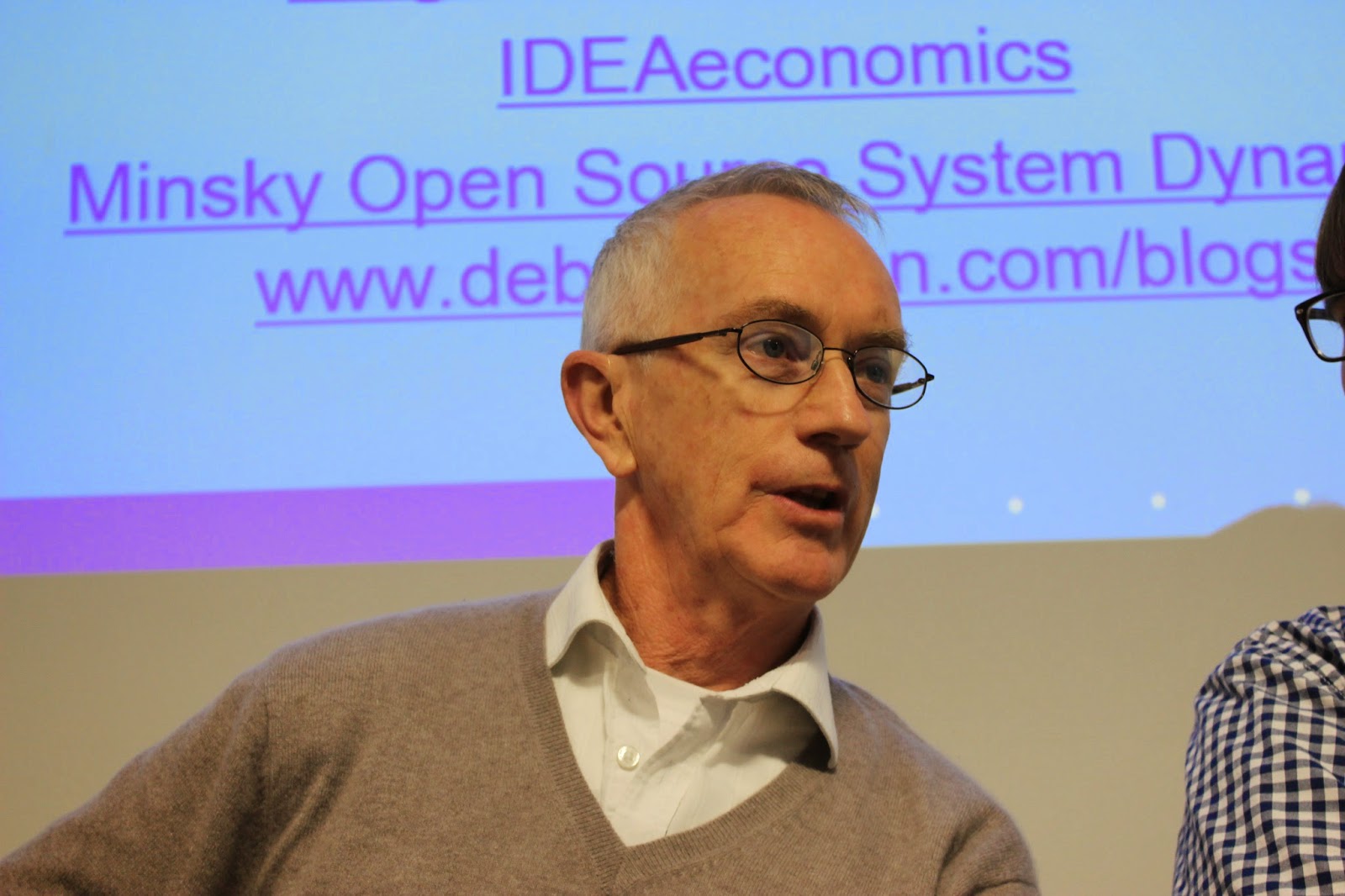
Professor Steve Keen launches Rethinking Economics Kingston

Students at Kingston University kicked off a campaign for a new approach to economics with the successful launch of new society Rethinking Economics Kingston this week.

Almost 100 people squeezed in to hear Professor Steve Keen – newly appointed head of the School of Economics, Politics and History – launch the new society with a speech on what’s wrong with mainstream economics and how students should change it.

Professor Keen - author of Debunking Economics and well-known critic of mainstream economics – described how theories taught in most economic classes were unable to predict, understand or even take on board the recent financial crisis.

Keen set out his vision for Kingston’s economics department as a beacon for students interested in a vibrant, pluralist atmosphere for learning. He also described his own history of challenging the narrow academic approach to economics while still a student.

Manav Chaudhary from LSE’s Post Crash Economics Society described the rapid growth of the Rethinking Economics movement and the enthusiasm of students across the country in campaigning for better economics teaching.

Professor Keen said:

“Across the world, students are calling for realism in economics, and demanding to be taught all schools of thought, not just the dominant one that was caught completely unawares by the economic crisis. Most University departments are resisting this call—amazing in itself for a discipline that claims to be about markets, and in which the consumer is supposed to be king. Kingston is responding to this call. We are going to provide our students with a complete, honest, warts-and-all, introduction to all the strands of thinking in economics. I’m delighted that Kingston students have formed their own Rethinking Economics group, and I’d encourage students at other universities to do the same. Change in economics will only come from the young, and with pressure from the public for economics to be realistic.”

Kingston's Rethinking Economics group are on Facebook, and there's a video of the event.

Thursday, 13 November 2014

Book Review Series: A Menagerie of Speculative Follies


Review of The Pit and the Pendulum: A Menagerie of Speculative Follies, by David Harding & James W. Holmes (Winton Ed.)

Reviewer: Vardhan Kapoor
The Pit and the Pendulum: A Menagerie of Speculative Follies is an ambitious work which covers 700 years of financial crises through the looking glass of waves of optimism and pessimism.  The global financial crisis triggered an array of literature on the history of finance including David Graeber’s Debt: The First 5000 Years and Niall Ferguson’s The Ascent of Money. This addition to the literature is a welcome one, as it aims to break with some of the questionable assumptions that dog the academic discipline of economics and economic history.
The book analyses forty-six episodes of financial folly divided into seven eras, beginning with "Merchants, Kings and Projectors (1300-1700)" through "Napoleons, Titans and Pashans (1880-1900)" and finishing with "Yuppies, Tycoons & Quants (1985-2008)". The names of the themes reflect the erudite vivacity of the work, which includes an astounding amount of pertinent and symbolic art from the time of the events, as well as peppered insights from the academic literature.


The acquiescence of economic departments towards the validity of their methodology after the crash was a source of concern for the founders of Rethinking Economics. One of the most pervasive aspects of economics and economic history is its reliance on models that rely on a very particular sense of rational expectations as their starting premise. It is therefore very pleasing that, while pursuing detailed statistical analyses, David Harding’s explicitly aims to challenge the notion that markets are governed by an unalterable rationality: "Markets are human institutions, vital to progress, but they are not perfect. They reflect the humanity of their participants, and therefore we should neither worship nor despise them". This is an important nuance, one that some of the greatest economics minds have been quick to point it out; as Albert Hirschman said of Adam Smith, it wasn’t the government which he despised, but rather, their folly.

As a whole, the work proves extremely readable set of snapshots into instances of financial mania. There is a certain levity with respect to the suffering caused by the financial crashes through history; the narrative betrays a sense of wonder at the endless possibilities of market dynamics, but the book would benefit from having solutions to these issues. In a way, the lesson to take from it is that financial mania has a way of putting all of us under its spell. Ultimately the book succeeds in providing a scrumptious read.

Monday, 27 October 2014

Press Release: Rethinking Economics Position on CORE Curriculum


This month Rethinking Economics released a statement on its position on the new CORE curriculum being trialled at some institutions in the UK. Continue reading below for this statement, or visit the Rethinking Economics website to download a PDF copy.

London, UK- 16 October 2014 - The CORE Curriculum is not an answer to our demands for reform. CORE is more engaging in its teaching style, but falls short of creating broader content.

RE does not currently endorse any curriculum; instead, we have written our vision of a pluralistic curriculum (http://www.rethinkeconomics.org/#!our-vision/colf) and we support the ISIPE open letter, which we contributed to along with 65 student groups (www.isipe.net). We encourage educators and curriculum writers to sign up to publically support these visions.

What we are looking for is curricula that embody the three pluralisms: pluralism in methodology, pluralism in schools of thought, and pluralism in disciplines. This means at least a key role for the history of economic thought in a way that encourages debate over different schools of thought.

We believe it is important to introduce students to a critical approach to social science in general, meaning that students can engage in debate over schools of thought, rather than be introduced to one narrative. CORE does not supply this in its present state.

Rethinking Economics welcomes progress in economics education, a small part of which CORE has achieved, but we believe firmly there is still much more to be done in economics education reform.


ABOUT: Rethinking Economics is an international network of student groups, academics and professionals that are calling for change in the way economics is taught in higher education. Through a mixture of campaigning, events and engaging projects, Rethinking Economics connects people globally to discuss and enact the change needed for the future of economics, and to propel the vital debate on what economics is today.

Contact:
Joe Richards (Press Officer)
Rethinking Economics
www.rethinkeconomics.org
press@rethinkeconomics.org
Telephone: +44 (0) 7743 855305

ENDS 

Tuesday, 5 August 2014

Don't Rock the Ideological Boat (Too Much)

David Wells

In his opening keynote address at the recently-concluded Rethinking Economics conference in London (June 28-29, 2014), Lord Adair Turner dismissed the need for changes to microeconomics by referring to the beneficial use made of micro by two committees he chaired, the Pensions Commission and the Low Pay Commission.
        
His committees may well have benefited from microeconomic insights but that does not leave micro in the clear. After all, the centrepiece of the micro banquet is the model of perfect competition which is foundational for the theory of General Equilibrium which in turn lies behind those models which assured mainstream economists that the financial crash of 2008 was not merely unlikely but actually logically impossible: so micro has a lot to answer for.
        
Lord Turner then focused his attention entirely on macroeconomics. The obvious problem with this limitation is that it leaves most of the foundations of mainstream orthodox economics intact and so student rebels against orthodoxy are likely to be disappointed.

Every session I attended at the conference included at least one reference to ideology. In addition,'Whig' as in Whig history was heard at least once, and 'neoliberal' several times.
        
Yet no-one put these themes together to actually come out and say plainly that the ideology of mainstream economics is (extreme) liberal, let alone to argue that this ideology which naturally and inevitably promotes laissez faire and free markets and so on, leads to distorted and inadequate models of experience, as seen in current economic textbooks and in the 2008 crash.

Ha-Joon Chang in his concluding keynote called forcefully and eloquently for pluralism in economics teaching, without considering that some of the schools of thought within economics that he identified preach (the correct word) ideas and claims that are deeply ideological and deeply damaging, the prime culprit being the hegemonic and extreme liberal neoclassical school. Thus, I presume that DSGE models ought not to be included in any pluralist course, except possibly as a terrible example of ivory tower economists running amok.

Finally, just before the final keynote address, a short video was played in which Robert Johnson, the President of INET, sent his best wishes to the conference and congratulated the organisers - but also suggested at one point that the students should be 'guided' by INET.
        
This is strange. Why should the students be 'guided' by INET ? Why not the other way around? After all, it is the students who are the instigators of this revolution and who are at the front line, manning the barricades. INET are very active in their own way - the CORE curriculum project is especially interesting - and they supply invaluable funding, including for this conference*, but they are essentially secondary actors on the stage. The protagonists are the students, not just in the UK but all over the world: the ISIPE now has (at least) 65 member associations in 30 countries.

*        And for researchers. I applied for a grant myself and was rejected, probably quite rationally.

Putting these points together, and writing as one of the older generation who was actually there at the time, I am reminded of the 1965 essay by Herbert Marcuse on 'Repressive Tolerance'.
        
Lord Turner is happy to use his vast experience to re-examine macroeconomics, but the foundations are, frankly, OK. Everyone acknowledges that ideology is present, but no-one actually wants to analyse it deeply. Robert Johnson wishes the students well but hopes that they will accept his avuncular guidance, while Ha-Joon Chang favours pluralism but without examining any ideological skeletons that various schools might be hiding in their cupboards.


If I were a student, I think that I would find this extremely disturbing.

David Wells can be contacted at davidggwells@yahoo.co.uk