Friday, 21 November 2014

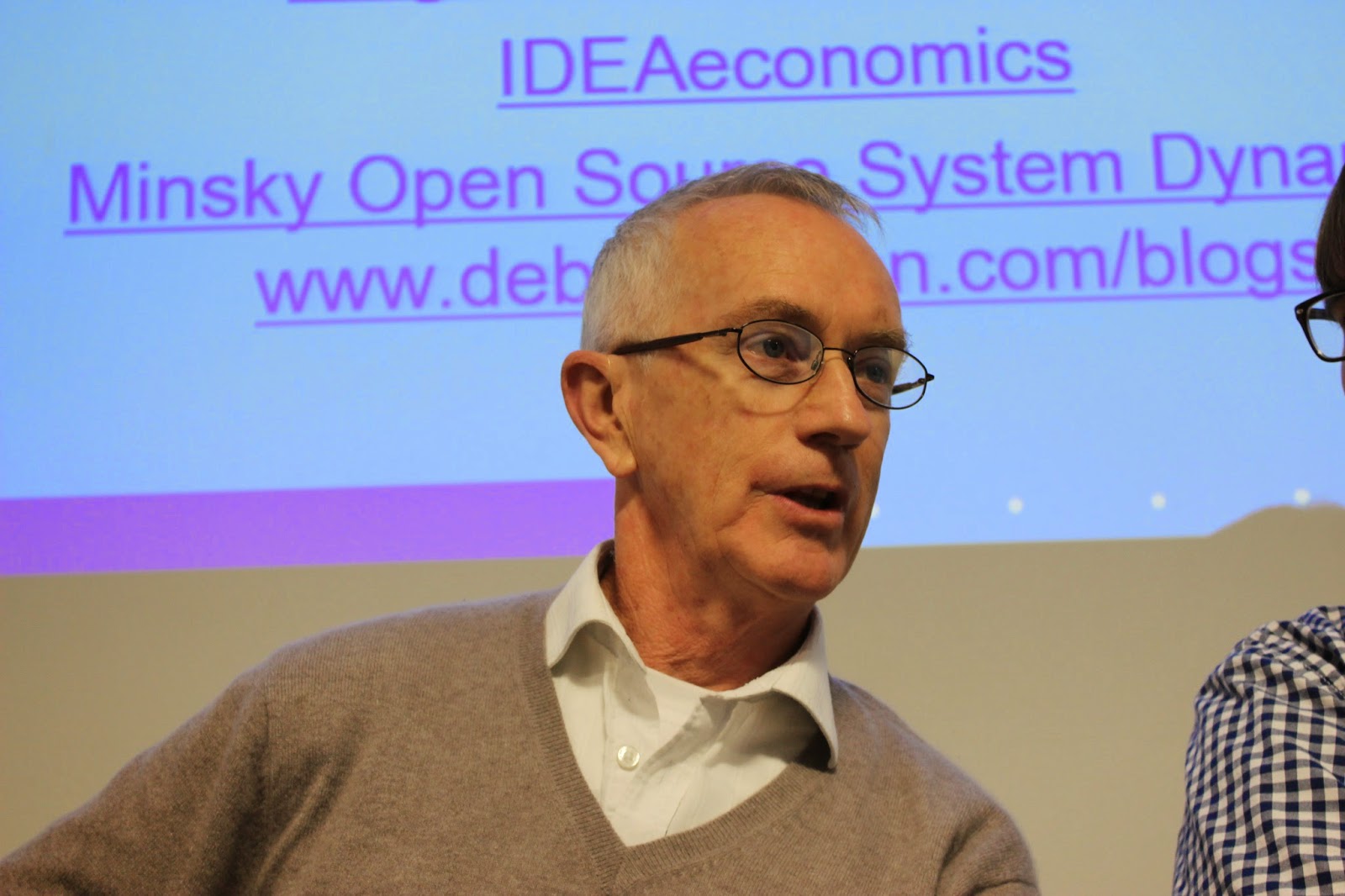
Professor Steve Keen launches Rethinking Economics Kingston

Students at Kingston University kicked off a campaign for a new approach to economics with the successful launch of new society Rethinking Economics Kingston this week.

Almost 100 people squeezed in to hear Professor Steve Keen – newly appointed head of the School of Economics, Politics and History – launch the new society with a speech on what’s wrong with mainstream economics and how students should change it.

Professor Keen - author of Debunking Economics and well-known critic of mainstream economics – described how theories taught in most economic classes were unable to predict, understand or even take on board the recent financial crisis.

Keen set out his vision for Kingston’s economics department as a beacon for students interested in a vibrant, pluralist atmosphere for learning. He also described his own history of challenging the narrow academic approach to economics while still a student.

Manav Chaudhary from LSE’s Post Crash Economics Society described the rapid growth of the Rethinking Economics movement and the enthusiasm of students across the country in campaigning for better economics teaching.

Professor Keen said:

“Across the world, students are calling for realism in economics, and demanding to be taught all schools of thought, not just the dominant one that was caught completely unawares by the economic crisis. Most University departments are resisting this call—amazing in itself for a discipline that claims to be about markets, and in which the consumer is supposed to be king. Kingston is responding to this call. We are going to provide our students with a complete, honest, warts-and-all, introduction to all the strands of thinking in economics. I’m delighted that Kingston students have formed their own Rethinking Economics group, and I’d encourage students at other universities to do the same. Change in economics will only come from the young, and with pressure from the public for economics to be realistic.”

Kingston's Rethinking Economics group are on Facebook, and there's a video of the event.

Thursday, 13 November 2014

Book Review Series: A Menagerie of Speculative Follies


Review of The Pit and the Pendulum: A Menagerie of Speculative Follies, by David Harding & James W. Holmes (Winton Ed.)

Reviewer: Vardhan Kapoor
The Pit and the Pendulum: A Menagerie of Speculative Follies is an ambitious work which covers 700 years of financial crises through the looking glass of waves of optimism and pessimism.  The global financial crisis triggered an array of literature on the history of finance including David Graeber’s Debt: The First 5000 Years and Niall Ferguson’s The Ascent of Money. This addition to the literature is a welcome one, as it aims to break with some of the questionable assumptions that dog the academic discipline of economics and economic history.
The book analyses forty-six episodes of financial folly divided into seven eras, beginning with "Merchants, Kings and Projectors (1300-1700)" through "Napoleons, Titans and Pashans (1880-1900)" and finishing with "Yuppies, Tycoons & Quants (1985-2008)". The names of the themes reflect the erudite vivacity of the work, which includes an astounding amount of pertinent and symbolic art from the time of the events, as well as peppered insights from the academic literature.


The acquiescence of economic departments towards the validity of their methodology after the crash was a source of concern for the founders of Rethinking Economics. One of the most pervasive aspects of economics and economic history is its reliance on models that rely on a very particular sense of rational expectations as their starting premise. It is therefore very pleasing that, while pursuing detailed statistical analyses, David Harding’s explicitly aims to challenge the notion that markets are governed by an unalterable rationality: "Markets are human institutions, vital to progress, but they are not perfect. They reflect the humanity of their participants, and therefore we should neither worship nor despise them". This is an important nuance, one that some of the greatest economics minds have been quick to point it out; as Albert Hirschman said of Adam Smith, it wasn’t the government which he despised, but rather, their folly.

As a whole, the work proves extremely readable set of snapshots into instances of financial mania. There is a certain levity with respect to the suffering caused by the financial crashes through history; the narrative betrays a sense of wonder at the endless possibilities of market dynamics, but the book would benefit from having solutions to these issues. In a way, the lesson to take from it is that financial mania has a way of putting all of us under its spell. Ultimately the book succeeds in providing a scrumptious read.

Monday, 27 October 2014

Press Release: Rethinking Economics Position on CORE Curriculum


This month Rethinking Economics released a statement on its position on the new CORE curriculum being trialled at some institutions in the UK. Continue reading below for this statement, or visit the Rethinking Economics website to download a PDF copy.

London, UK- 16 October 2014 - The CORE Curriculum is not an answer to our demands for reform. CORE is more engaging in its teaching style, but falls short of creating broader content.

RE does not currently endorse any curriculum; instead, we have written our vision of a pluralistic curriculum (http://www.rethinkeconomics.org/#!our-vision/colf) and we support the ISIPE open letter, which we contributed to along with 65 student groups (www.isipe.net). We encourage educators and curriculum writers to sign up to publically support these visions.

What we are looking for is curricula that embody the three pluralisms: pluralism in methodology, pluralism in schools of thought, and pluralism in disciplines. This means at least a key role for the history of economic thought in a way that encourages debate over different schools of thought.

We believe it is important to introduce students to a critical approach to social science in general, meaning that students can engage in debate over schools of thought, rather than be introduced to one narrative. CORE does not supply this in its present state.

Rethinking Economics welcomes progress in economics education, a small part of which CORE has achieved, but we believe firmly there is still much more to be done in economics education reform.


ABOUT: Rethinking Economics is an international network of student groups, academics and professionals that are calling for change in the way economics is taught in higher education. Through a mixture of campaigning, events and engaging projects, Rethinking Economics connects people globally to discuss and enact the change needed for the future of economics, and to propel the vital debate on what economics is today.

Contact:
Joe Richards (Press Officer)
Rethinking Economics
www.rethinkeconomics.org
press@rethinkeconomics.org
Telephone: +44 (0) 7743 855305

ENDS 

Tuesday, 5 August 2014

Don't Rock the Ideological Boat (Too Much)

David Wells

In his opening keynote address at the recently-concluded Rethinking Economics conference in London (June 28-29, 2014), Lord Adair Turner dismissed the need for changes to microeconomics by referring to the beneficial use made of micro by two committees he chaired, the Pensions Commission and the Low Pay Commission.
        
His committees may well have benefited from microeconomic insights but that does not leave micro in the clear. After all, the centrepiece of the micro banquet is the model of perfect competition which is foundational for the theory of General Equilibrium which in turn lies behind those models which assured mainstream economists that the financial crash of 2008 was not merely unlikely but actually logically impossible: so micro has a lot to answer for.
        
Lord Turner then focused his attention entirely on macroeconomics. The obvious problem with this limitation is that it leaves most of the foundations of mainstream orthodox economics intact and so student rebels against orthodoxy are likely to be disappointed.

Every session I attended at the conference included at least one reference to ideology. In addition,'Whig' as in Whig history was heard at least once, and 'neoliberal' several times.
        
Yet no-one put these themes together to actually come out and say plainly that the ideology of mainstream economics is (extreme) liberal, let alone to argue that this ideology which naturally and inevitably promotes laissez faire and free markets and so on, leads to distorted and inadequate models of experience, as seen in current economic textbooks and in the 2008 crash.

Ha-Joon Chang in his concluding keynote called forcefully and eloquently for pluralism in economics teaching, without considering that some of the schools of thought within economics that he identified preach (the correct word) ideas and claims that are deeply ideological and deeply damaging, the prime culprit being the hegemonic and extreme liberal neoclassical school. Thus, I presume that DSGE models ought not to be included in any pluralist course, except possibly as a terrible example of ivory tower economists running amok.

Finally, just before the final keynote address, a short video was played in which Robert Johnson, the President of INET, sent his best wishes to the conference and congratulated the organisers - but also suggested at one point that the students should be 'guided' by INET.
        
This is strange. Why should the students be 'guided' by INET ? Why not the other way around? After all, it is the students who are the instigators of this revolution and who are at the front line, manning the barricades. INET are very active in their own way - the CORE curriculum project is especially interesting - and they supply invaluable funding, including for this conference*, but they are essentially secondary actors on the stage. The protagonists are the students, not just in the UK but all over the world: the ISIPE now has (at least) 65 member associations in 30 countries.

*        And for researchers. I applied for a grant myself and was rejected, probably quite rationally.

Putting these points together, and writing as one of the older generation who was actually there at the time, I am reminded of the 1965 essay by Herbert Marcuse on 'Repressive Tolerance'.
        
Lord Turner is happy to use his vast experience to re-examine macroeconomics, but the foundations are, frankly, OK. Everyone acknowledges that ideology is present, but no-one actually wants to analyse it deeply. Robert Johnson wishes the students well but hopes that they will accept his avuncular guidance, while Ha-Joon Chang favours pluralism but without examining any ideological skeletons that various schools might be hiding in their cupboards.


If I were a student, I think that I would find this extremely disturbing.

David Wells can be contacted at davidggwells@yahoo.co.uk

Thursday, 17 July 2014

Get Involved - Call for New Organisers

Want to join the Rethinking movement? We are looking for new organisers! Contact Yuan at rethinkeconomics.org to get involved :)

Newsletter Coordinator - Gather together news from around the RE network for our fortnightly letter. Let the world and our members know what is happening.

Secretary/Note-taker - Keep us all organised and up to date. Attend RE meetings and help us follow up on projects we agree to do together, by keeping all members of the group informed as to what has been discussed and agreed.

Media Coordinator - Be the front line for responding to the many print, online, radio and tv requests we get each week. Organise who is responding to what. You can also do interviews yourself if you like.

New Groups Liaison Officer - Take care of the expanding Rethinking Economics network. Be the first point of call for new groups who want help in starting up (can be grouped into locality or language if you prefer).

All these roles will be given plenty of training, help and contact with existing organisers to ease you into the role. Don’t let lack of experience stop you from getting involved!